Why Contractors Are Ditching Night Guards for Security Trailers

Wired
Quick Answer: Mobile security trailers cost 60 to 90 percent less than a 24/7 night guard on a construction site, offer wider coverage than any single person can provide, and stay on duty without breaks, no-shows, or worker's compensation exposure. Guards still make sense for daytime access control and physical response, but for overnight perimeter protection in New Mexico, contractors are increasingly running trailers alone or paired with a shorter daytime guard shift.
Choosing between a mobile security trailer vs a night guard for construction sites in New Mexico used to be a straightforward guard hire. Not anymore. Guard hourly rates have climbed, no-show incidents have hit contractors mid-project, and a single guard can only cover one field of view at a time. Meanwhile, a mobile security trailer runs 24/7 without shift changes, monitors an entire site perimeter at once, and often costs a fraction of what a live guard bills for the same coverage window.
Here is the honest cost, coverage, and deployment breakdown of a mobile security trailer vs a night guard on a New Mexico construction site.
Are Mobile Security Trailers Cheaper Than Night Guards?
Yes, a mobile security trailer is significantly cheaper than a night guard for equivalent overnight construction site coverage, with the savings typically landing in the 60 to 90 percent range. A single guard billed at $25 to $30 per hour for 24/7 coverage runs $18,000 to $22,000 per month before benefits, overtime, and holiday premiums. A monitored mobile security trailer covering the same perimeter usually runs a small fraction of that, and it does not stop for breaks, sick days, or shift changes.
The gap widens the longer the project runs. Guard costs scale linearly with time. Trailer costs stay flat. On a 12-month project, the difference between a full-guard security budget and a trailer-based one can fund a meaningful chunk of the site's security infrastructure elsewhere. Our post on why renting an LVT security trailer costs more than you think covers the rental-vs-purchase math in more detail if you are weighing a longer deployment.
Can a Mobile Security Trailer Replace a Night Guard on a Construction Site?
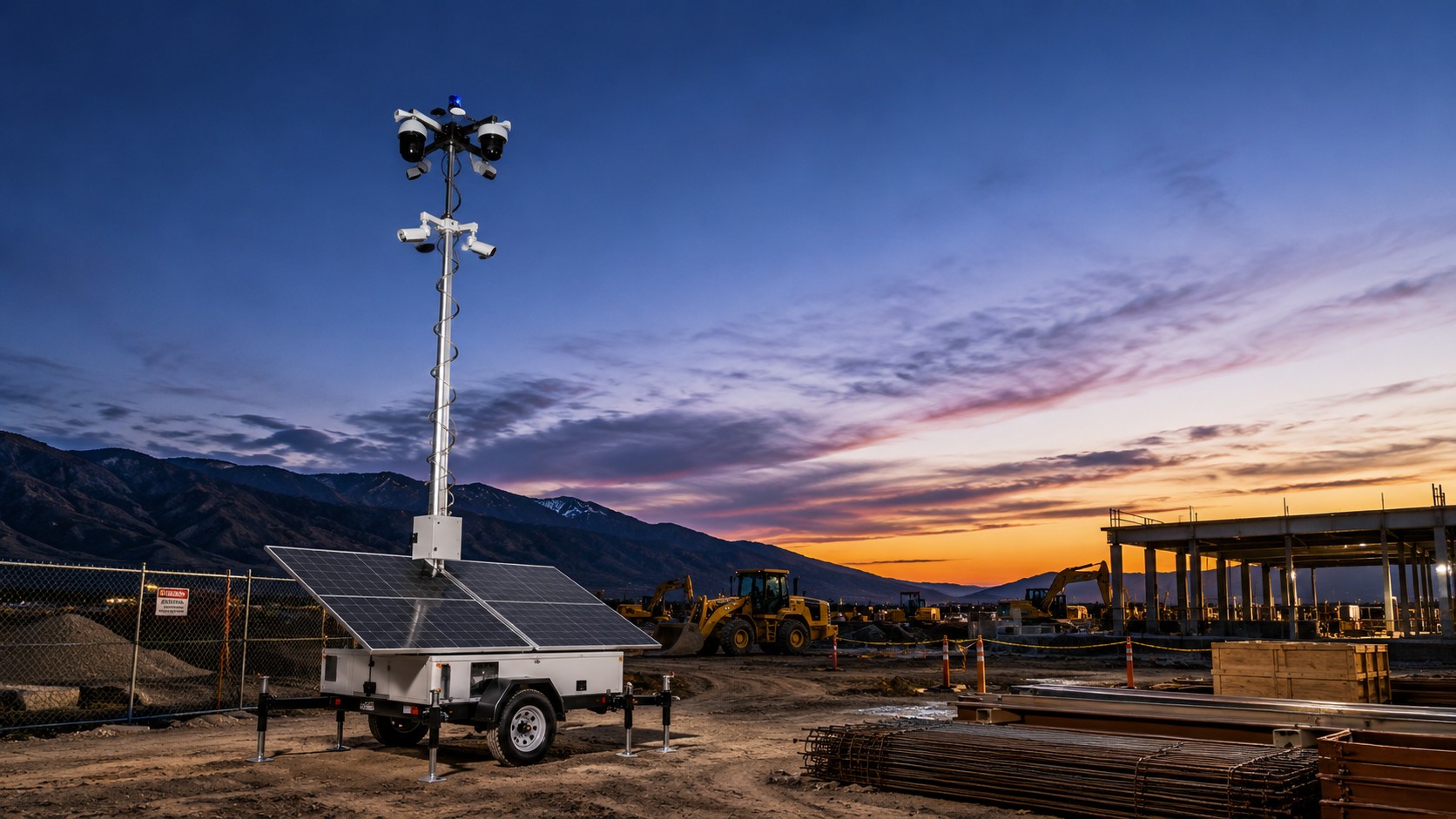
A mobile security trailer can replace a night guard on most construction sites for overnight perimeter protection, but only if you deploy it professionally and connect it to live remote monitoring. A recording-only trailer is not a guard replacement. It is just a fancy camera post. What replaces the guard is the combination of visible cameras, floodlights, motion detection, live audio deterrence, and a monitoring center that can dispatch law enforcement in real time.
What a properly deployed trailer does that a night guard cannot:
- Watches every corner of the site perimeter at once instead of one field of view
- Sees in the dark with infrared and thermal cameras
- Never sleeps, calls out sick, or takes a smoke break at the wrong minute
- Records every event for legal-quality video evidence
- Delivers live audio warnings that make trespassers turn around before a crime happens
- Alerts monitoring operators who dispatch law enforcement with real-time context
What a night guard can do that a trailer cannot:
- Physically check IDs, sign in vendors, and lock or unlock gates
- Respond hands-on to a fire, injury, or vehicle breakdown
- Interact with subcontractors, delivery drivers, and inspectors during the day
That is why the answer for most New Mexico contractors is not "one or the other." It is "trailer for overnight, guard during work hours if you need one at all." Our post on the Verkada security trailer for Albuquerque projects walks through the exact deployment profile most job sites need.
Do You Still Need a Guard if You Have a Security Trailer On-Site?
You do not need a guard for overnight perimeter coverage if you have a properly monitored security trailer on-site, but many contractors keep a daytime guard for access control and visitor management. The trailer handles what a guard cannot cover at scale: continuous perimeter watch, evidence capture, and deterrence. The guard handles what a trailer cannot: physical presence, human judgment, and hands-on response.
The most common hybrid setup New Mexico contractors are running:
- Overnight and weekends: Monitored trailer alone, no guard
- Weekdays during work hours: One access-control guard at the main gate
- Holidays and shutdowns: Trailer only, with elevated monitoring alerts
This structure catches the largest theft window without paying a premium for a guard to sit through overnight hours when the trailer is doing the real work. According to the National Insurance Crime Bureau, construction equipment theft losses in the United States run between $300 million and $1 billion annually, and most incidents happen at night or on weekends when nobody is on-site. That is exactly the window a trailer is designed to cover.
When a Security Trailer Is Not the Right Call
A mobile security trailer is not the right fit for every construction site, and pretending otherwise is how contractors end up with the wrong tool on the wrong project. Trailers work best on open lots with clear sightlines, active perimeters, and no permanent power or camera infrastructure yet installed. There are a handful of situations where a guard, a fixed camera system, or a hybrid of both makes more sense.
Cases where a trailer is the weaker choice:
- Tight urban infill sites where the mast has no clear line of sight and buildings block camera angles
- Short-duration projects under 30 days where mobilization and setup eat the cost savings
- Sites requiring frequent hands-on visitor management like busy healthcare or government builds with heavy inspection traffic
- Finished-shell buildings where permanent camera and access control installation makes more long-term sense than a mobile unit
- Sites with severe network dead zones where cellular monitoring cannot maintain a reliable connection
For most other New Mexico construction sites, especially the dirt-lot and mid-build phases where equipment and materials sit exposed overnight, a monitored trailer is the strongest overnight coverage a contractor can put in the ground for the money.
Why New Mexico Contractors Are Making the Switch
New Mexico contractors are under active pressure from copper theft, equipment theft, and job site trespassing across Albuquerque, Rio Rancho, and Santa Fe. Local law enforcement response times to alarm calls have stretched in recent years, and one guard on a large open lot is easy to circle around. A mobile security trailer with cameras at the top of an extended mast covers the whole site at once, records every incident, and gives insurance carriers the documented footage they need to process a claim without pushback.
Insurance pressure drives the same switch. Commercial policies for construction operations increasingly require documented perimeter coverage. A trailer with continuous recording satisfies that requirement in a way a rotating guard schedule cannot document as cleanly. Wired has installed and deployed LVT trailers on active job sites across New Mexico since 2005, and the pattern is consistent: contractors who move from guard-heavy security to a trailer-first setup cut their monthly security spend without losing coverage.
Get a Free Deployment Quote Before Your Next Project Starts
Wired designs, deploys, and monitors the mobile security trailers New Mexico contractors run on active construction sites. We handle the site assessment, mast placement, camera coverage plan, cellular connectivity, and 24/7 monitoring so the trailer starts protecting your equipment the day it arrives. Our mobile security command trailers pair Verkada cameras with proactive monitoring on a single platform, which is exactly what carrier-friendly documentation and construction-site theft deterrence require.
Ready to price a trailer against your current guard bill? Contact Wired for a free security assessment in Albuquerque or anywhere across New Mexico, and see how much a mobile security trailer would save you over a live guard on your next project.