Addressable vs Conventional Fire Alarms: Which Is Right for You?

Wired
When it comes to addressable vs conventional fire alarm systems, the right choice depends entirely on your building's size, layout, and how much information you need when an alarm goes off. Both systems are NFPA-compliant. Both will alert occupants to a fire. But they work very differently — and choosing the wrong one for your facility can mean slower emergency response, higher long-term costs, or a system that can't keep up as your building grows.
This guide explains how each system works, who each one is designed for, and how to know which is the right fit for your New Mexico commercial building.
How Conventional Fire Alarm Systems Work
A conventional fire alarm system divides your building into zones. Each zone — say, a floor, a wing, or a section — is wired to a central control panel on its own circuit. When any detector in that zone triggers an alarm, the panel shows which zone is affected.
That is the key limitation: a conventional system tells you the zone, not the specific device. If you have 20 smoke detectors on the second floor all wired to a single zone, and one of them triggers, the panel shows "Zone 2 — Second Floor." A technician or first responder then has to physically search that entire zone to find the source.
Conventional systems use simple wiring — each detector on a circuit runs in sequence from the panel to the last device. This makes them straightforward to install and understand. It also means that if a wire is cut or damaged anywhere in the circuit, every device after that cut loses connection to the panel.
Conventional systems are best suited for:
- Small buildings under roughly 25,000 square feet
- Simple layouts with easy-to-search zones — small retail spaces, standalone offices, small warehouses
- Facilities with limited budgets where basic zone-level detection is sufficient
- Buildings that don't require integration with HVAC, access control, or building management systems
How Addressable Fire Alarm Systems Work
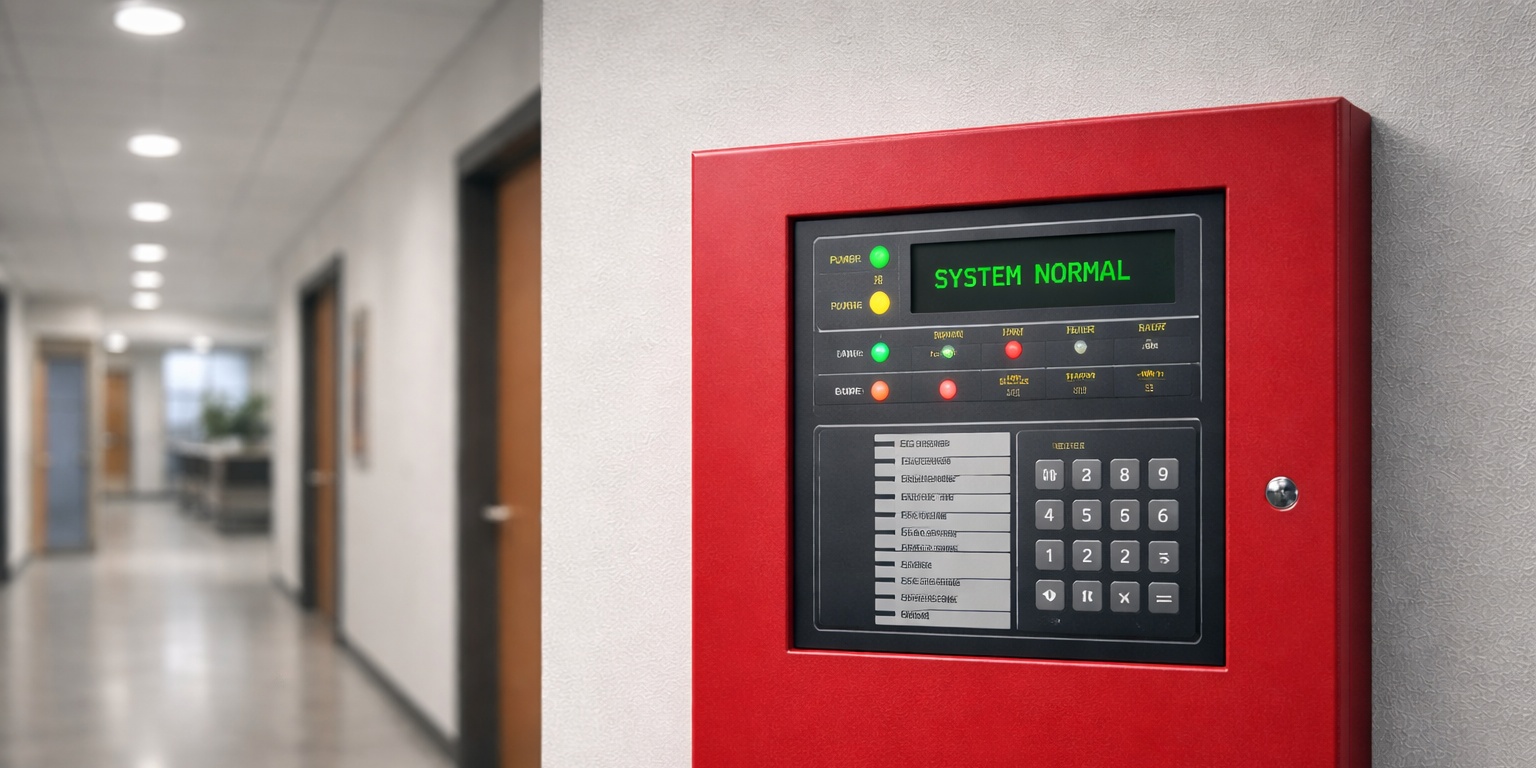
An addressable fire alarm system assigns a unique digital address to every single device — every smoke detector, heat detector, pull station, and module in the building. Each device communicates directly with the Fire Alarm Control Panel (FACP) over a signaling line circuit (SLC), which is a single loop of wire that connects all devices back to the panel.
When any device triggers an alarm, the panel shows the exact device that activated — not just the zone. In a five-story office building with 200 detectors, an addressable system tells you it was specifically smoke detector #47 in Room 312 on the third floor. First responders know exactly where to go before they even enter the building.
Because the wiring runs as a loop rather than a radial circuit, addressable systems have built-in fault tolerance. If a wire is cut at one point, the panel can still communicate with all other devices by routing signals the other direction around the loop. In a conventional system, that same cut would knock out every device downstream of it.
Addressable systems are also intelligent — each device can report its own status, including whether it's working correctly, whether it needs cleaning, or whether it's approaching the end of its service life. This capability makes maintenance dramatically more efficient because you know exactly which device needs attention before it fails.
Addressable systems are required or strongly recommended for:
- Buildings over 25,000 square feet
- Multi-story or multi-wing buildings where pinpointing a fire's exact location matters
- Schools, healthcare facilities, and government buildings where precision evacuation is critical
- Buildings that need integration with HVAC, access control, emergency lighting, elevators, or PA systems
- Multi-tenant or mixed-use commercial buildings
- Any facility planning to expand — addressable systems scale without major rewiring
Addressable vs Conventional Fire Alarm Systems: Side-by-Side Comparison
| Feature | Conventional | Addressable |
|---|---|---|
| Alarm location detail | Zone only | Exact device and location |
| Wiring | Radial circuit per zone | Single loop, all devices |
| Wire fault tolerance | Cut wire disables all downstream devices | Loop continues to function if cut |
| Device monitoring | No — zone only | Yes — each device reports status |
| Scalability | Limited — new zones require new circuits | High — add devices to existing loop |
| System integration | Limited | Full — HVAC, access control, PA, elevators |
| Upfront cost | Lower | Higher |
| Long-term maintenance cost | Higher (harder to troubleshoot) | Lower (self-diagnostics) |
| Best for | Small, simple buildings | Medium to large or complex facilities |
NFPA 72 Compliance: Does It Matter Which System You Choose?
Both conventional and addressable fire alarm systems can meet NFPA 72 — the National Fire Alarm and Signaling Code that governs fire alarm installation, testing, and maintenance across the country. NFPA 72 does not mandate one system type over the other. It requires that whichever system you install meets the performance and safety standards for your building's occupancy type and use.
What this means in practice is that the choice between addressable and conventional comes down to your building's specific needs — not a code requirement to pick one over the other. However, local Albuquerque codes and the Authority Having Jurisdiction (AHJ) may have specific requirements for certain building types or occupancies. Wired designs all systems to NFPA 72 and local Albuquerque code from the start, and handles all permit and AHJ acceptance testing as part of the installation process.
One important note: the 2025 edition of NFPA 72 adds new requirements for advanced features including cybersecurity protection and sophisticated sensing capabilities. These requirements are much easier to meet with addressable systems, which is one more reason larger or more complex facilities are moving toward addressable as the standard.
When Conventional Systems Make Sense
Conventional is not a bad choice — it is simply a choice designed for a specific kind of building. If you run a small retail shop, a standalone office with a simple floor plan, or a single-story warehouse where any alarm would be quickly found by staff, a conventional system may be entirely appropriate and will meet code for your occupancy type.
The lower upfront cost is a genuine advantage for small facilities with tight budgets and straightforward layouts. For a 3,000 square foot office with one floor and five rooms, a zone-based system does its job effectively.
Conventional starts to break down when:
- Your building has multiple floors or large open areas where finding the triggered device takes time
- You need to integrate the fire alarm with other systems
- Your building is likely to expand or renovate in the future
- You need detailed event logs for compliance or liability documentation
When Addressable Systems Are the Right Call
For most commercial buildings in New Mexico — offices, schools, healthcare facilities, multi-tenant retail, government buildings, and any building over one story — an addressable system is the better long-term investment even with the higher upfront cost.
The ability to pinpoint the exact device that triggered an alarm saves critical minutes during an emergency. First responders know exactly where to go. Staff can begin targeted evacuation before fire crews arrive. And your monitoring center receives device-level detail that enables a faster, more informed response.
The integration capability is also increasingly important. An addressable fire alarm can be configured to automatically shut down HVAC to stop smoke circulation, unlock emergency exits via access control, recall elevators to the ground floor, activate emergency lighting, and trigger PA announcements — all simultaneously the moment a device activates. A conventional system cannot do any of that.
Wired installs addressable fire alarm systems for offices, schools, healthcare facilities, government buildings, and commercial properties across Albuquerque, Rio Rancho, Santa Fe, and throughout New Mexico. Our fire alarm installation team handles everything from engineered drawings and permits through AHJ acceptance testing, staff training, and 24/7 UL-listed monitoring.
Can You Upgrade from Conventional to Addressable?
Yes — and it is more common than most building owners expect. Many older commercial buildings in New Mexico were originally equipped with conventional systems that made sense at the time. As those buildings expand, change occupancy, or need to integrate with modern security systems, upgrading to addressable becomes the right move.
A retrofit from conventional to addressable does not always require completely new wiring. In many cases, existing low-voltage infrastructure can be reused or extended. Wired assesses your current system and gives you a clear picture of what an upgrade involves before any work begins.
One important consideration: if your conventional system is aging, the cost of continuing to maintain it often approaches the cost of upgrading. Old conventional panels are harder to get parts for, and troubleshooting zone-based systems without device-level diagnostics takes more labor time. An addressable upgrade often pays for itself through reduced maintenance costs over a few years.
Not Sure Which System Your Building Needs?
The right fire alarm system depends on your building's size, layout, occupancy type, integration needs, and budget. There is no one-size-fits-all answer — but there is a right answer for your specific facility, and getting it right the first time saves money and headaches down the road.
Wired makes it simple. Contact us today for a free fire alarm consultation. We'll walk through your building, review your current system if you have one, and give you a clear recommendation — conventional, addressable, or a hybrid approach — based on exactly what your facility needs to meet code and keep people safe.