New Mexico Dispensary Security Requirements: Pass Your CCD Inspection

Wired
New Mexico dispensary security requirements are not optional — meet them or risk losing your license. The Cannabis Control Division (CCD) inspects every licensed cannabis retailer, and security is one of the first things they check. The good news is that if you know exactly what they're looking for, you can get it right the first time.
This guide breaks down all five categories the CCD evaluates, what most dispensaries get wrong, and how the right security system keeps you compliant and protected in 2026.
Why CCD Security Inspections Matter
The CCD has the authority to suspend or revoke your license for security violations. A failed inspection doesn't just cost you time — it can shut your business down. Many dispensary owners don't realize how specific these requirements are until they're already in front of an inspector.
The regulations come from N.M. Admin. Code § 16.8.2 under the Cannabis Regulation Act. They cover five main areas: physical security, video surveillance, alarms, documentation, and incident reporting. We'll go through each one.
New Mexico Dispensary Security Requirements: The Full Breakdown
1. Physical Security & Access Control
Physical security is the foundation of your compliance plan. Before the CCD even looks at your cameras, they check whether your building itself is secure.
New Mexico requires:
- Commercial-grade locks on all external entrances, perimeter doors, and windows — they must be high-security and in good working condition
- Limited-Access Area (LAA) barriers — any area used for storage, weighing, packaging, or POS transactions must be physically restricted from general access
- Required signage — every LAA entrance must display a 12" x 12" sign reading "Do Not Enter – Limited Access Area"
- Adequate lighting — all exterior perimeter entry points and LAAs must be lit well enough for cameras to capture clear footage 24/7. Perimeter lighting must cover activity within 20 feet of any gate or entry point. Motion-activated lighting is allowed in low-traffic areas as long as coverage standards are still met.
A standard commercial deadbolt is not enough. The CCD expects locks that meaningfully deter forced entry. If a door handle jiggles or a window lock is flimsy, that's a citable violation before an inspector even pulls up your camera footage.
Wired installs access control systems including Verkada door readers and Salto smart locks that replace traditional keys with credential-based entry — giving you full control over who enters every restricted area, and a digital record of every access event.
2. Video Surveillance System
This is the area where most dispensaries fall short. New Mexico's camera requirements are specific, and a consumer-grade DVR setup will not pass.
The CCD requires:
- 24/7 continuous recording — cameras must run at all times, not just when motion is detected
- Minimum resolution of 1280 x 720 pixels at a minimum of 15 frames per second
- Camera coverage of all POS stations, all entrances and exits, all storage rooms, and the room where your recording device itself is stored
- 30 days of stored footage at minimum — any incident involving theft or a security breach must be retained for 12 months
- Immediate failure alerts — your system must notify you the moment recording stops for any reason
- The recording device must be kept in a locked, limited-access room to prevent tampering or theft
If your DVR goes offline and nobody knows for three days, that's a compliance violation — even if nothing bad happened. The failure alert requirement alone disqualifies most off-the-shelf systems.
Wired installs Verkada security cameras that record in 4K — far above the 720p minimum — with up to 365 days of onboard storage. Verkada sends automatic alerts the moment a camera goes offline, and all footage is backed up to the cloud so it can't be stolen, erased, or damaged. You can access every camera remotely from a phone or laptop, and pull footage instantly if the CCD requests it.
For more on camera options, visit our security camera installation page.
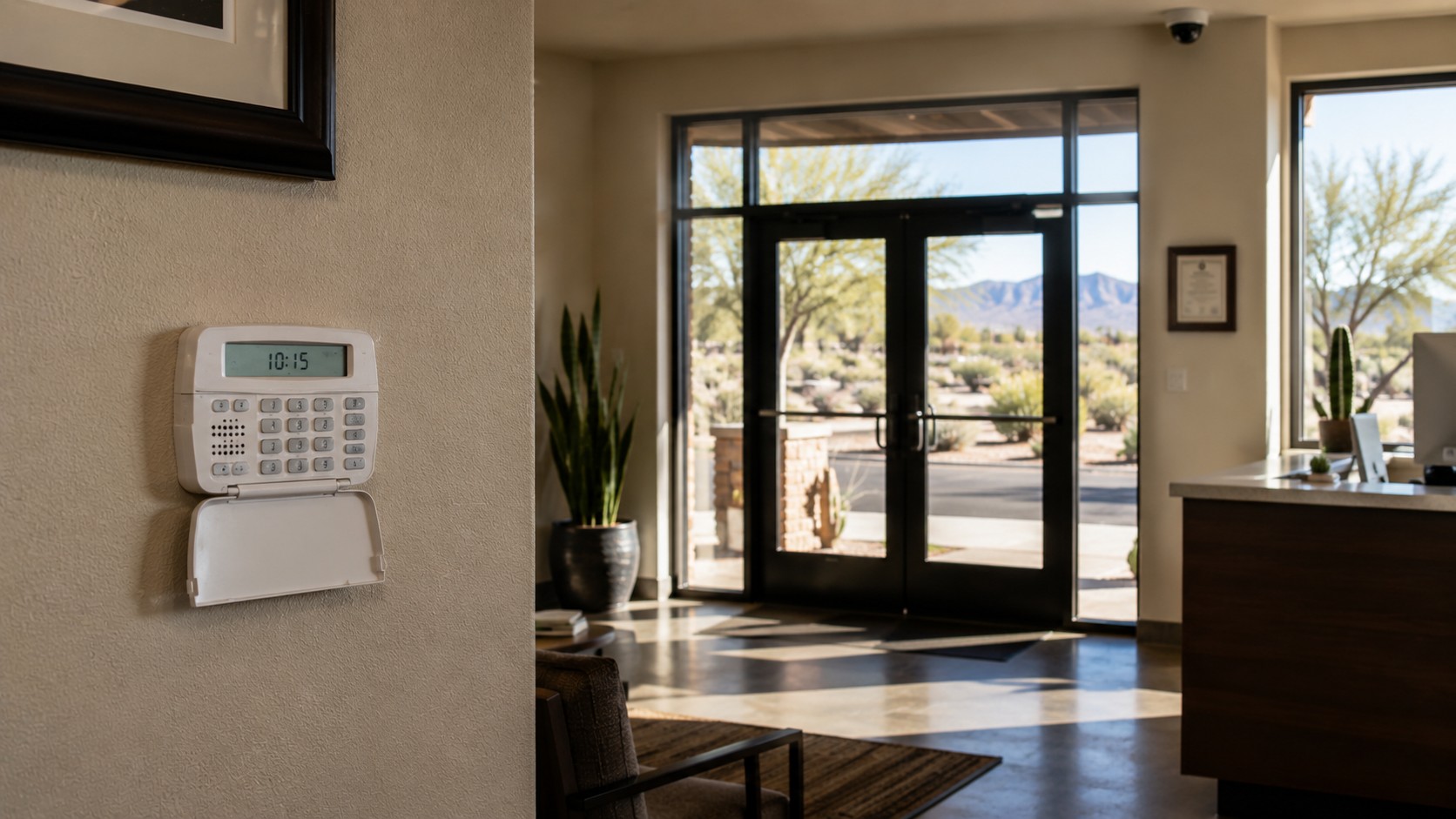
3. Alarm System & Monitoring
An alarm is only as good as what happens after it goes off. New Mexico requires your system to be actively monitored — not just installed and forgotten.
Specifically, the CCD requires:
- Central station monitoring or another CCD-approved monitoring method operating at all times
- Sensors on all perimeter entry points and windows — every possible entry must be covered
- The system must be capable of alerting designated employees and/or law enforcement within 5 minutes of an alarm trigger
- Silent panic/holdup buttons installed at every POS station and in all back-office areas
A basic alarm with no monitoring contract will not pass. The CCD wants documented proof that a real, fast response will happen when something goes wrong. Panic buttons are especially important — staff need a way to silently alert for help during a robbery without escalating the situation.
Verkada's alarm system integrates directly with cameras and access control, so when an alarm triggers, your monitoring team sees live video immediately. Panic button support is built in at POS stations. Everything logs automatically for your compliance records.
4. Digital Documentation & Auditing
This section trips up a lot of dispensaries because it goes beyond hardware. The CCD expects an ongoing paper — or digital — trail that proves your security systems are working and your facility is being run properly.
Requirements include:
- Employee ID badges — every staff member must wear a visible, laminated badge showing their first name, a unique employee number, and a color photo at least 1 inch wide and 1.5 inches tall
- Daily visitor logbook — a record of every non-employee entering any LAA, including their arrival time, departure time, and purpose of visit. All visitors must wear a visible ID badge while inside any LAA.
- Inventory reconciliation — monthly audits comparing your physical inventory to BioTrack NM data are required
- Maintenance logs — written records of all security system tests, repairs, and upgrades must be kept for a minimum of 12 months
- Chain of custody documentation — every product transfer must be documented with electronic or paper forms that include signatures and batch/lot numbers
The visitor log alone is something many dispensaries handle with a clipboard and a loose sheet of paper. That's a problem when an inspector asks to review six months of records. Verkada Guest replaces the paper log with a digital visitor management system — every check-in is timestamped, searchable, and stored automatically.
Maintenance log requirements also mean your security vendor needs to document every service visit, firmware update, and system test. Wired provides that documentation as part of our service relationship, so you're never scrambling before an inspection.
5. Incident Reporting
If something goes wrong, the clock starts immediately. New Mexico requires:
- Any theft, robbery, or security breach must be reported to the CCD in writing within 24 hours of discovery
- Licensees must be ready to provide police reports and related video footage to the CCD upon request
- Video footage of incidents must be retained for 12 months
This means your footage must be accessible, organized, and actually retrievable when needed — not buried on a DVR that takes 20 minutes to navigate. With Verkada, you can pull and share a specific clip in seconds from any device.
How One Integrated System Covers Every New Mexico Dispensary Security Requirement
Meeting these requirements with mismatched equipment from different vendors is how dispensaries end up with gaps. One system handles hardware, monitoring, access logs, visitor records, and documentation — all in one place.
Here's how Wired's solutions map directly to CCD requirements:
- Physical security: Salto smart locks and Verkada access control replace standard locks with credential-based entry and full audit trails
- Cameras: Verkada cameras record in 4K with up to 365 days of retention, automatic failure alerts, and cloud backup
- Camera installation: Our security camera installation team designs coverage plans that eliminate blind spots and meet every placement requirement
- Alarms: Integrated alarm monitoring with central station support, perimeter sensors, and panic button installation at every POS station
- Visitor logs: Verkada Guest creates a digital, timestamped record of every visitor — fully searchable and audit-ready
- Low-voltage infrastructure: Our low-voltage cabling team ensures your entire system runs on a solid, professional foundation
- Documentation: Wired provides maintenance logs for every service visit, update, and test — exactly what the CCD wants to see
- One dashboard: Everything is managed remotely from a single platform, accessible from any device
The Most Common Reasons Dispensaries Fail a CCD Security Inspection
Even well-run dispensaries make these mistakes:
- Weak or residential-grade locks on LAA doors and exterior entrances
- Missing or incorrectly sized LAA signage — the 12x12 requirement is exact
- Camera blind spots — especially over the storage device room and back-office areas
- No recording failure alert — a DVR offline for days with nobody knowing
- Incomplete visitor logs — missing timestamps, missing departure times, or gaps in records
- No active monitoring contract for the alarm system
- No maintenance logs — system tests and repairs never documented
- Paper chains of custody that are incomplete or inconsistent with BioTrack data
Each of these is a citable violation on its own. Together, they can result in a suspension or license revocation.
Don't Wait Until Your Inspection to Find Out You're Not Compliant
New Mexico dispensary security requirements exist to protect your business, your staff, and your license. Meeting them shouldn't be a guessing game. Wired works with cannabis businesses across Albuquerque, Santa Fe, Rio Rancho, and throughout New Mexico to design and install security systems that are built to pass inspection — and built to last.
Ready to get your dispensary compliant? Contact Wired today for a free security consultation. We'll walk through your facility, identify any gaps, and get you a system that checks every box the CCD is looking for.