What Is ZeroEyes? How AI Gun Detection Works with Existing Cameras

Wired
ZeroEyes gun detection is an AI-powered software system that analyzes your existing security cameras in real time, identifies a visible firearm the moment it appears on screen, and alerts law enforcement and your security team in as fast as 3 to 5 seconds. It does not replace your cameras. It does not require a full infrastructure overhaul. And it is the only AI-based gun detection platform to earn full U.S. Department of Homeland Security SAFETY Act Designation — meaning it has been independently tested and proven effective as an anti-terrorism technology.
If you have digital IP security cameras already installed, ZeroEyes can be added to what you already have. This guide breaks down exactly how it works, who it is designed for, and what makes it different from other security technologies.
The Problem ZeroEyes Solves
Traditional security cameras record everything — but they do not react to anything. A camera pointed at your lobby captures everything that happens, including the moment someone walks in with a firearm. But that footage does not alert anyone. By the time someone reviews the footage or a bystander calls 911, critical seconds are already gone.
The average law enforcement response time to an active shooter incident is several minutes. Studies consistently show that the first 60 to 90 seconds of a gun-related incident are the most critical window for intervention. ZeroEyes gun detection is designed to close that gap — turning passive cameras into an active, always-on threat detection system that gets the right information to the right people before shots are fired.
How ZeroEyes Gun Detection Works: Step by Step
The process is fast, specific, and human-verified at every stage. Here is exactly what happens from the moment a gun appears on camera.
Step 1: AI Scans Your Camera Feeds Continuously
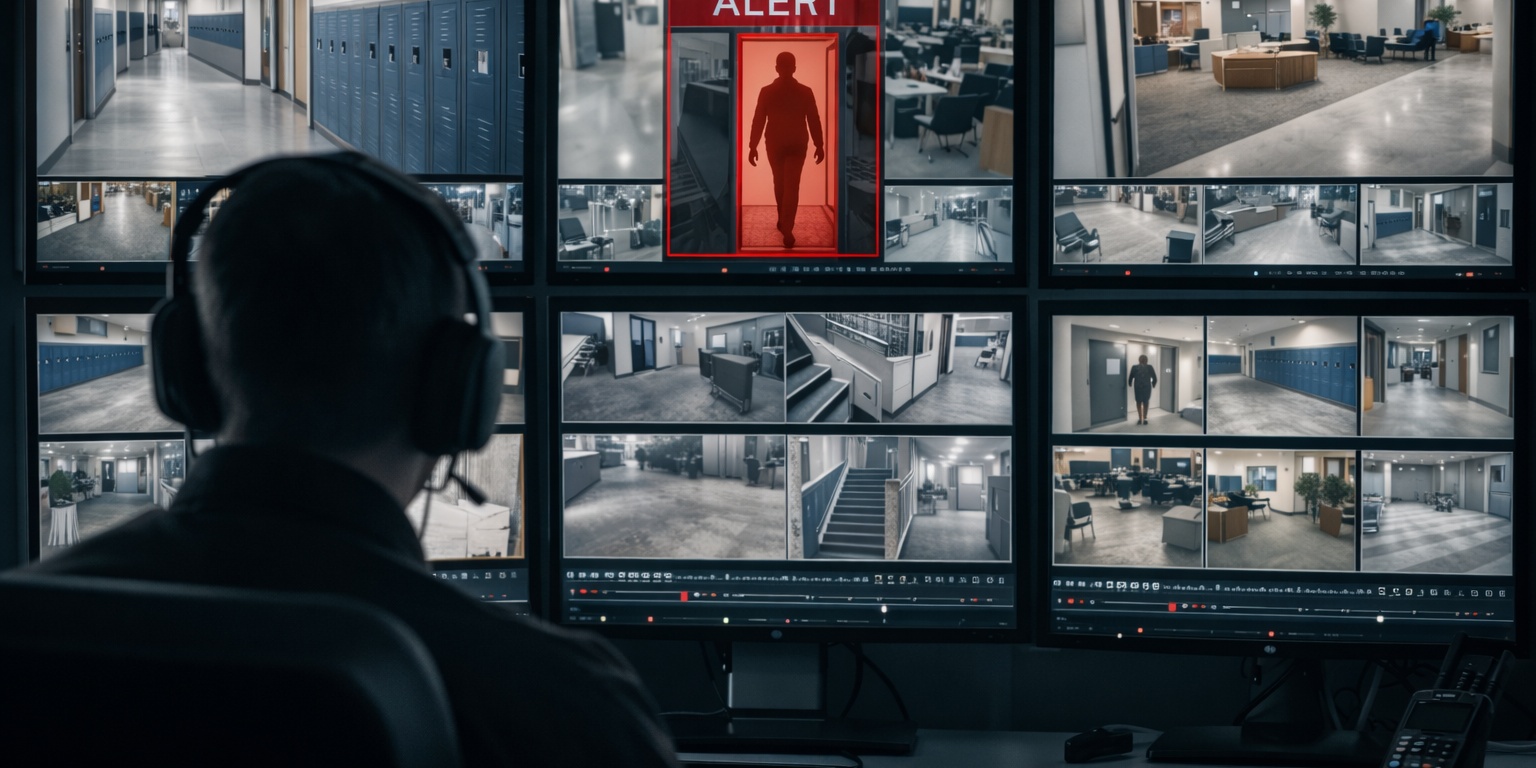
ZeroEyes software connects to your existing IP security cameras and analyzes the video feeds in real time. The AI processes over 36,000 images per second across all connected cameras simultaneously. It runs 24 hours a day, 7 days a week, 365 days a year — without breaks, without fatigue, and without missing a frame.
The AI is trained specifically and exclusively to detect firearms. It is not facial recognition technology. It does not record, store, or share images of people. It does not perform voice recognition or any other invasive surveillance. Its only function is to identify the visual signature of a gun in a camera frame.
Step 2: AI Detects a Firearm and Flags the Image
When the AI identifies what it believes is a firearm, it captures that image and immediately forwards it to the ZeroEyes Operations Center — the ZOC. This happens within a fraction of a second of detection. The system does not wait, does not pause, and does not require anyone on your end to initiate the process.
Step 3: Human Analysts Verify the Threat
This step is what separates ZeroEyes from fully automated systems. The ZOC is staffed 24/7/365 by trained U.S. military veterans and law enforcement professionals. When a flagged image arrives, a human analyst reviews it immediately to confirm whether a real firearm is present. This human-in-the-loop verification dramatically reduces false alarms and ensures that every alert that goes out is a real, confirmed threat — not a false positive from a tool, a prop, or a reflection.
Step 4: Alerts Go Out in 3 to 5 Seconds
Once a ZOC analyst confirms a firearm, alerts go out simultaneously — often within 3 to 5 seconds of the initial detection. Those alerts go to:
- Your on-site security personnel via mobile app and desktop notification
- Designated facility administrators
- Local law enforcement and 911 dispatch via RapidSOS integration
Each alert includes the visual description of the person, the type of firearm, and the exact location of the threat — down to the specific camera zone and area of the building. Law enforcement does not arrive asking what happened. They arrive knowing where to go.
According to ZeroEyes' own technology documentation, this process results in an average 50% reduction in 911 dispatch response times for facilities using the system.
Step 5: Integration Triggers Your Response Protocols
ZeroEyes does not just send a notification. It integrates with your existing security infrastructure to trigger the response protocols you already have in place. Depending on how your system is configured, a confirmed detection can automatically:
- Lock down specific doors or the entire facility via access control integration
- Trigger PA announcements or mass notification alerts to building occupants
- Stream live camera feeds directly to responding law enforcement
- Activate lockdown procedures linked to your emergency operations plan
What Buildings and Facilities Use ZeroEyes?
ZeroEyes is deployed across a wide range of environments. The common thread is any facility where people gather and where a gun-related incident would have catastrophic consequences.
Current ZeroEyes deployments include:
- K-12 schools and universities — one of the most active deployment categories, driven by post-Uvalde pressure on school administrators to add proactive detection layers
- Healthcare facilities — hospitals and clinics face a high rate of gun-related workplace incidents and often have limited security staff relative to facility size
- Government buildings — courthouses, municipal offices, and public service facilities
- Corporate campuses — Fortune 500 companies and large employers with multiple buildings and high foot traffic
- Retail and shopping centers — including big-box stores and malls where large crowds and multiple entry points create detection challenges
- Transit systems — the Regional Transportation Commission of Southern Nevada deployed ZeroEyes and saw a 40% reduction in passenger assaults and a 26% drop in operator assaults in 2024
- Places of worship — churches, mosques, and synagogues that have seen increased security threats in recent years
In New Mexico specifically, schools, government facilities, healthcare campuses, and commercial properties are all strong candidates given the state's active threat environment and the prevalence of firearms in the region.
Does ZeroEyes Work with Cameras I Already Have?
In most cases, yes. ZeroEyes connects to existing digital IP security cameras — it does not require you to replace your entire camera system to get started. The ZeroEyes deployment process begins with a site assessment that evaluates your current camera infrastructure, identifies any coverage gaps, and determines which cameras are best positioned for optimal detection performance.
There are some minimum camera quality requirements. Older analog cameras or very low-resolution systems may need to be upgraded for the AI to perform accurately. Wired conducts a thorough camera evaluation as part of every ZeroEyes deployment to identify exactly what you have, what meets the standard, and what may need to be upgraded.
For facilities that do need camera upgrades, Wired installs Verkada security cameras that are fully compatible with ZeroEyes and bring your overall surveillance quality up significantly beyond the minimum requirement.
Is ZeroEyes the Same as Facial Recognition?
No — and this is one of the most common questions facilities ask before deploying. ZeroEyes is object detection technology, not biometric surveillance. The AI is trained solely to identify the visual characteristics of firearms. It does not identify, track, or store information about any individual person. It does not use facial features, voice patterns, or any biometric data.
ZeroEyes does not receive, record, store, or share video or images of any person beyond the specific flagged image sent to the ZOC for firearm verification. That image is used only for the purpose of confirming or clearing the detection. This design was intentional — the founders built ZeroEyes to address gun violence specifically without creating the privacy concerns associated with facial recognition systems.
This distinction matters especially for schools and government facilities in New Mexico, where privacy concerns around surveillance technology are increasingly scrutinized.
What Makes ZeroEyes Different from Other Weapons Detection Systems?
ZeroEyes is often compared to physical weapons detection systems like Evolv Express. They serve different purposes and are frequently used together rather than as alternatives.
- Evolv Express detects concealed weapons — firearms, knives, and other threats hidden under clothing — at physical entry points. People walk through a detection zone before entering a building.
- ZeroEyes detects visible, brandished firearms anywhere on camera — inside a building, in a parking lot, in a hallway, or in any area covered by IP cameras. It works after someone has already entered.
Together, they create a layered defense: Evolv catches threats at the door, ZeroEyes catches threats that make it past the door or originate inside. Many schools and large facilities deploy both for complete coverage.
The other key differentiator is the human verification layer. Most automated detection systems send alerts directly without human confirmation — leading to high false alarm rates that erode trust and cause alert fatigue. ZeroEyes' model of AI detection followed by immediate human verification at the ZOC means that when an alert goes out, it is a confirmed threat. That distinction matters enormously to law enforcement response.
How Wired Deploys ZeroEyes in New Mexico
As a certified ZeroEyes installer serving Albuquerque, Rio Rancho, Santa Fe, and facilities throughout New Mexico, Wired handles every phase of deployment:
- Site assessment: Evaluating your current camera infrastructure, identifying coverage zones, and determining integration points with access control and alarm systems
- Camera upgrades if needed: Installing compatible IP cameras where existing cameras don't meet ZeroEyes' detection requirements
- Software integration: Connecting ZeroEyes to your camera feeds, configuring network requirements, and setting up alert routing to your security personnel and local law enforcement
- Protocol integration: Linking gun detection alerts to lockdown systems, PA announcements, access control, and your emergency response plan
- Staff training: Teaching your security and administrative teams how to respond to alerts and coordinate with the ZOC and law enforcement
- Ongoing support: Monitoring system performance, coordinating software updates, and assisting with coverage expansion as your facility grows
Add Proactive Gun Detection to Your Facility
Your cameras are already watching. ZeroEyes makes them react. Whether you run a school, a hospital, a government building, or a commercial facility in New Mexico, adding ZeroEyes gun detection to your existing camera infrastructure is one of the most impactful security upgrades available today.
Ready to see how ZeroEyes would work in your facility? Contact Wired today for a free consultation. We'll assess your current cameras, identify any gaps, and build a deployment plan that gets you protected as quickly as possible.